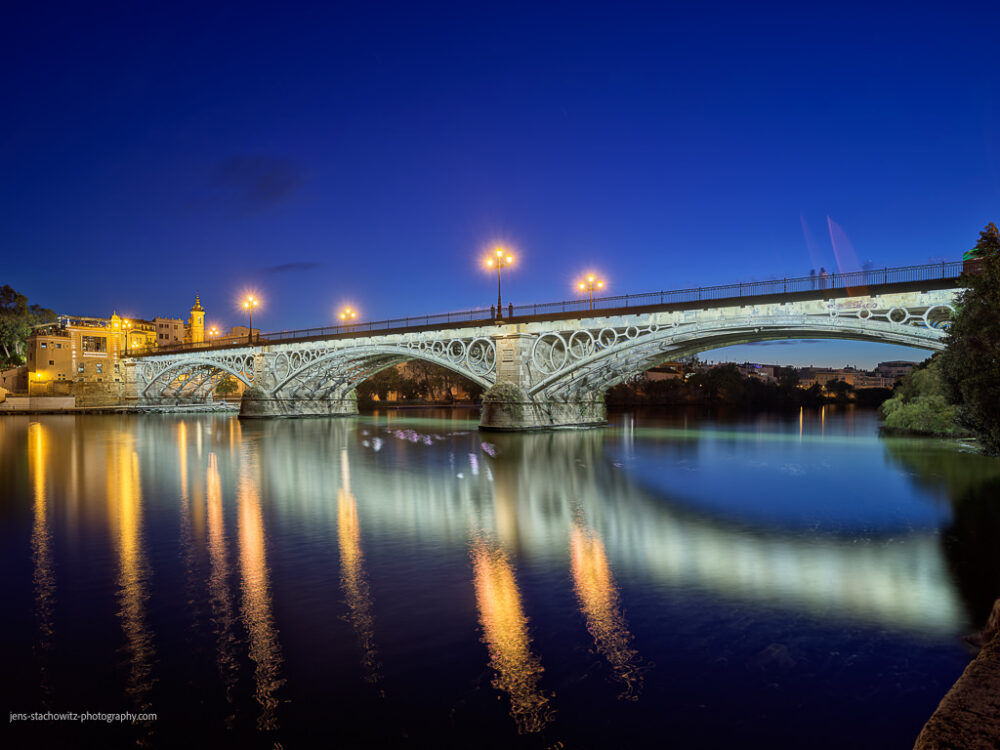
The Puente de Isabel II, commonly known as Puente de Triana, is a historic iron bridge in Seville, Spain. It connects the city’s old town with the Triana neighborhood across an old arm of the Guadalquivir River. The bridge spans 136.5 meters with three iron arches and two stone piers, making it Spain’s oldest surviving iron bridge.
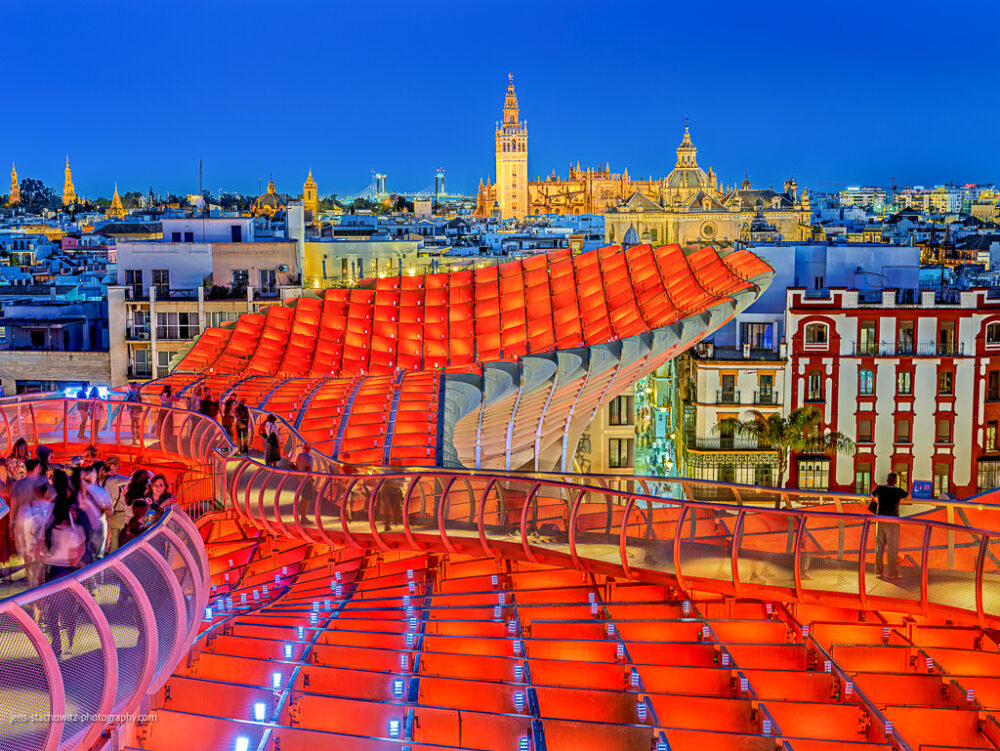
Setas de Sevilla, also known as Metropol Parasol, is a striking wooden architectural structure resembling giant mushrooms in Seville’s Plaza de la Encarnación. Designed by German architect Jürgen Mayer, it spans 150 meters long, 70 meters wide, and up to 26 meters high, making it one of the world’s largest wooden structures.
Enduring rainfalls for weeks caused floddings all over the more nothern parts Germany in December 2023. Here in Ruhrort, where the floodplains usually are a leisure area, the lanterns shine, although the area is not accessible, but they bathe the scene in a beautiful light.
Bourla Theatre (also known as Bourlaschouwburg) is a theatre located in Antwerp that seats around 900. The building is designed in a neoclassical style on the site of the former Tapissierspand tapestry market. The theatre was designed on request from the city in 1827 by the city architect Pierre Bourla. Construction began in 1829, but was delayed due to the Belgian Revolution. The theatre was finally finished in 1834 and opened under the name, Grand Théâtre or Théâtre Royal Français, on account of its ownership by a French company. Presently, the Bourla houses the theatre company Het Toneelhuis, which is a merger of the companies, Koninklijke Nederlandse Schouwburg and Blauwe Maandag Compagnie.
The Bourla is the last remaining municipal theatre in Europe with original stage machinery, which fill five levels above and below the stage. The building has been named a protected building since 1938, and therefore is regarded among the most important historic buildings in Belgium.
A coking plant and a steelworks in Duisburg on the Rhine exhaust a lot of fumes and steam. If you take a longer walk to the banks of the river you can watch this spectacular vista.
Antwerp became a very rich community in the 16th century and these rich residents showed off their wealth. These guild houses are beautifully lit in the evening. Through intensive post-editing, I brought out these golden times even more clearly.
Tetraeder in Bottrop on top of the heap Beckstraße
The Tetraeder is one of many landmarks the Ruhr Area has built to signal their industrial past and its trust into its structural change. We walked up very early in the morning during the summer solstice to catch the sunrise. Fortunately this moment was fare more beautiful than the sunset itself. After the sunset we hat a very early breakfast atop the artificial hill made of tailings form the nearby coal mines.
To honor the may miners in the Ruhr Area and to spend a little comfort after the mining industry has gone this landmark was set up in Moers on top of the heap Rheinpreussen, what is the name of the former nearby coal mine. A lamp like this was constructed in a way that prevents an explosion which occurs when methane was set free. In modern days electric light were used.
Coking plant Schwelgern at the river Rhine @ Jens Stachowitz
There still is heavy industry in the Ruhr Area and part of that ist this coking plant that supplies the nearby blast furnances. This photograph was taken from the other side of the river Rhine in oder to picture the whole very large plant and the beautiful reflections of the lights at the blue hour.